Showing posts with label 7 Habits. Show all posts

Tuesday, March 15, 2016

Choices

{In case you didn't see it in yesterday's Facebook post, and because I need the reminder myself...}


imgflip.com/memegenerator

Happy Monday! Yes, I said, 'HAPPY'. Things may not be as you wish. You may not be where you expected to be in life. You may be experiencing illness, grief, loss, or loneliness. It may be raining outside. Or maybe you stubbed your toe. OR you're just plain at your wit's end with the inanity, idiocy, and inhumanity seemingly running rampant through popular culture, politics, and the media these days. Yes, things may suck,

BUT...

no matter what's going on 'out there', YOU STILL HAVE CONTROL over what's going on 'in here' - YOUR 'in here', that is. You have free will to choose your  behavior, even your thoughts - no matter your current situation and challenges. Use this freedom! Don't relinquish your power to other people, external situations, or the Fates. Choose your direction for yourself, damn it!

As I've heard in AA, "Choose the next right step." So, what will you choose today? What will your next right step' be???


Thursday, September 4, 2014

Reconnecting

Since school started two weeks ago, I've been one giant ball of stress. I've been so worried about all the little details of the projects I have going on with my club in particular that I'm forgetting the big picture. Stressing about the weeds, and losing sight of the forest. 

I need to reconnect to my mission. Why am I doing everything I'm doing? Why am I going back to school, involved in my student chapter, and actively pursuing employment in the field? It isn't to stress myself out. It's because I care about making a difference in the world. I care about helping other people - helping them to climb up with me in recovery from mental illness and addiction. That's the why.

There. I actually feel a little better now!

When you get stressed out by all that you have going on, take a few minutes to reconnect to your mission. Is what you are doing in alignment with your mission? If not, ditch it. Do you even have a mission written out? If not, take some time to contemplate it and put it into words. Your mission is your compass on the road to success.


Monday, June 23, 2014

The 7 Habits of Mental Wellness: Habit 3 - Put First Things First

This is the fourth article in the series: The 7 Habits of Mental Health Recovery - based on the late Stephen R. Covey's 7 Habits of Highly Effective PeopleSee "The 7 Habits of Mental Wellness" for the introduction to this series, as well as "Habit 1" and "Habit 2"

Habit 3 is Put First Things First. It is the habit of action. As with Habit 1 and Habit 2, before I go into how it relates to mental health, let me give you a little background on Habit 3 from the late Stephen R. Covey. 

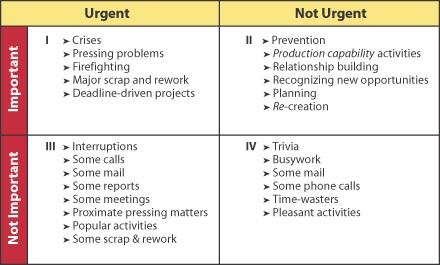
TIME MANAGEMENT MATRIX

Covey says that the way we spend our time is based on importance and urgency - that all activities fit into one of four categories:  urgent and important (Quadrant I), not urgent and important (Quadrant II), urgent and not important (Quadrant III), and not urgent and not important (Quadrant IV).

Quadrant I includes "crises, pressing problems, and deadline-driven projects"; Quadrant II, "prevention...relationship building, recognizing new opportunities, planning, and recreation"; Quadrant III, "interruptions, some calls, some mail...some meetings, proximate and pressing matters, and popular activities", and Quadrant IV, "trivia, busywork, some mail, some phone calls, time wasters, pleasant activities."

Quadrant III is driven by other people and not by our own goals, and Quadrant IV is entirely wasted time. The goal is to only spend time on that which is important - and ideally, to reduce Quadrant I by spending more time in Quadrant II.

[For a good visual, see Forbes.]

We can do this by learning to say "no" to Quadrants III and IV and by scheduling into our weekly plans Quadrant II activities which are based on our personal vision (see "Habit 2").

APPLICATION

When one is suffering from mental illness, time management usually falls by the wayside; but managing one's time in alignment with one's vision is one of the best things we can do for our recovery.

There are many ways to do this. Cell phones come equipped with calendars, reminders, and time management apps; and there are online to do lists like www.toodledo.com and www.rememberthemilk.com. However, I think they all fall short in connecting activities to vision.


The best tool I have found for this is the traditional, hard copy planner. I prefer it because it's actually quicker to enter something into a hard copy planner than a cell phone. Also, there are planner sections for capturing on paper the notes and activities of the various roles of one's life, as well as one's goals and vision. And, quite frankly, a planner is attractive to carry around!

Planners come in myriad colors, sizes, and materials; and there's a wide variety of inserts available as well.

For planners, check-out: 

www.daytimer.com

www.filofaxusa.com

www.franklincovey.com

For inserts, check out the above and, my absolute favorite, Life Is Crafted. With prompts for thought and inspirational quotes built right in, Life Is Crafted inserts capture your vision and passions and help you incorporate them into your monthly, weekly, and daily planning. For a great overview, check out A5 Planner Inserts Dotty 2014 Starter Pack Day Per Page and their other videos

Regardless, the medium you choose, the idea is to link your activities to your personal vision, so that you are living in alignment with your highest priorities and not carried away by the whims and urgencies of the day. 


Sunday, February 16, 2014

The Space Between

I'm still struggling. I spent most of the day today curled up on the couch again, waiting to feel better. Needless to say, it didn't work - I only feel worse. I really should heed my own advice, though, on Habit 1: Be Proactive and Habit 2: Begin with the End in Mind.

Okay, so how do I apply them? How do I get myself back on track again using Habits 1 and 2? Well, the vision I have for myself is of mental health and vitality (Habit 2). I also know that there is a space between the current stimulus (this empty, gnawing feeling of dread and fear) and my response to it. In that space, I have the freedom to choose my response (Habit 1). I can either curl up in the Vortex or do something to encourage mental health. Though I know the latter is the correct response, it feels painful. I must do it, though, in order to see my vision come to fruition. The other option is not acceptable and will cause me to spiral down further.

Okay, so what am I going to do right now? Later? I am going to get a large glass of water (not coffee) and I am going to read some of my textbooks. At 8:00, I am going to take my meds; and at 10:00, I am going to get into bed and get a normal night's sleep.

I am going to try this tonight and regroup in the morning with a new plan to stay on track tomorrow. 

I feel like a robot, breaking down the simplest of actions into logical little steps. Why do I over-complicate things? Why does it take such a herculean effort sometimes to make the simplest things happen? Anyway, I'll work my little plan, and we'll see what comes of it. 

I just want to cry...

Wednesday, February 12, 2014

The 7 Habits of Mental Wellness: Habit 2 - Begin with the End in Mind

This is the second article in the series: The 7 Habits of Mental Health Recovery - based on the late Stephen R. Covey's 7 Habits of Highly Effective People. See "The 7 Habits of Mental Wellness" for the introduction to this series, as well as "Habit 1".

Habit 2 is Begin with the End in Mind. It is the habit of vision. As with Habit 1, before I go into how it relates to mental health, let me give you a little background on Habit 2 from the late Stephen R. Covey. 

HABIT OF LEADERSHIP

According to Covey, "to begin with the end in mind means to start with a clear understanding of your destination. It means to know where you're going so that you better understand where you are now and so that the steps you take are always in the right direction." He adds that Habit 2 is the habit of leadership - of deliberately forging a direction rather than just mindlessly wandering along.

Covey said that "all things are created twice" first in the head, then in reality. First, we have a vision of what we want and then the vision becomes that which we act upon to attain the desired outcome.

He taught that we create our destination either deliberately, or by default. We choose our own vision and act accordingly to achieve it, or we let life happen to us even if we don't like where it's heading. Either way, we have created the outcome.

VISION

One exercise Covey suggests for beginning with the end in mind is to envision your 80th birthday. All of the important people from the various roles in your life are there: your family, friends, colleagues, associates in the community, etc. What do you want each of them to say about you? This is a starting point for your vision in each of your roles.

MISSION STATEMENT

After deep, thoughtful visioning of how we want our lives to be, how we want to be, and of determining our core values, we condense it into a map - an overarching theme that will guide our actions and goals. This road map is called a personal mission statement. 

APPLICATION

When one is suffering from mental illness, however, creating a mission and vision for oneself may seem one of the most impossible of tasks - but one that could mean the difference between life and death.  When I was at the end of my rope, my vision of the future was very limited and very dark. I saw no possibility, and my choices and chances seemed to grow more limited by the day. Finally, I reached a point were the only vision I had was that of an end to the pain of living.

Somewhere deep inside, however, a molecular-sized part of me did still cling to a faint vision that life could be different, and it was through this tiny vision that I was finally able to let go and ask for help. (Also where Habit 1 played a role.) Even though I had no hope, I had to let go of what little control I had left, and trust that even though I was in a dark, dark place with seemingly no way out, others (i.e., mental health care professionals) had a map to wellness and could help get me back on the road to a much better destination.

As I said before, to a mentally ill person, this may seem an impossible task - coming up with a vision for yourself, let alone crafting a written mission statement. But in the tiny act of letting go and trusting that there is a positive vision out there somewhere - even if we can't see it yet - we begin to act on that vision and create a better world for ourselves. 

With the help of mental health professionals, you will begin to create that vision. It will start as a Wellness Recovery Action Plan (WRAP), which details the daily steps you need to take to cope with your illness and climb out of the abyss. For now, this becomes your map, your vision, your mission. Then, as you begin to recover and reach for higher ground, you can delve into the personal work of creating your 80th birthday vision of your life, and eventually craft a personal mission statement which can become your guide to long-term mental health.

RESOURCES

If you cannot see any possibilities for your future, and death seems the only way out, please contact your health care provider, mental health professional, hospital, or the National Suicide Prevention Lifeline at www.suicidepreventionlifeline.org or 1.800.273.8255.

If you want to see a sample of a WRAP, email me at pink.hi.tops@gmail.com.

For guidance on crafting a mission statement, see FranklinCovey.com for a Mission Statement Builder  and other resources.

Tuesday, October 8, 2013

The 7 Habits: Paradigms and Principles

In The 7 Habits of Highly Effective People, the late Stephen R. Covey says that, rather than concern ourselves with becoming more productive with our time, we should concern ourselves with being more effective as people; and in order to be more effective, there are seven basic habits we must practice. These seven habits were a culmination of his graduate research. He studied the most successful people in history, and came to see a pattern emerge in how they lived their lives - seven basic habits that they all practiced. 

Over the course of the next few weeks, I will present here, The 7 Habits - an overview for those recovering from mental illness. Keep in mind I will only scratch the surface, and I highly recommend you read the book! 

May I present the first post in the series: The 7 Habits: Paradigms and Principles

--------------------------------------------------------------------------------------------------------
There are three constants in life...change, choice, and principles.

                                                                                      - Stephen R. Covey


Before we even begin to discuss Covey's 7 Habits, and how it can be applied to those who are dealing with mental illness, we need to understand two concepts: paradigms and principles.

Paradigms

Paradigms are the mental lens through which we view ourselves and our world. They are formed by  our upbringing, personal experiences, and personality. When the lens is correct, it gives an accurate lay of the land; but when it is off, it can be like looking into the fun house mirror at a carnival - what we see is distorted.

In his book, Covey shares a personal story to illustrate. I paraphrase here:

Once on a trip to New York, Covey was riding the subway. At one stop, a man and his children boarded the car. The man slumped down in a chair apathetically while his children proceeded to run up and down the car disrupting the passengers. After a few minutes of watching this and getting more and more upset, he finally said something to the man, "Do you think you can control your kids? They're disrupting everyone on the train!"

The man looked up at him and said, "Oh yeah, sorry. I guess they don't know how to handle it. We just left the hospital where their mother died an hour ago."

Covey immediately saw the situation in a different light and proceeded to console the man for the remainder of the ride.

That shift in Covey, and in us as we read the story, is an example of a paradigm shift - a change in the lens through which we analyze a situation or perceive the world.

Okay, so how do we know if our paradigms are correct or if they need shifting? We continually strive to improve and learn from our experience. We study the wisdom literature and thinking of the great leaders / thinkers throughout history and from our own spiritual path / religion and align our paradigms with the principles that emerge.

Principles

Keep in mind, principles are not the same as values. Values may be things we cherish like health, money, and close relationships. Principles, on the other hand, are deeper and universal. They are changeless laws of character that exist whether we choose to acknowledge them or not. To illustrate this point, here is an excerpt from the 7 Habits in which Covey shares a story by Frank Koch, originally published in the Naval Institute's Proceedings magazine:

Two battleships assigned to the training squadron had been at sea on maneuvers in heavy weather for several days. I was serving on the lead battleship and was on watch on the bridge as night fell. The visibility was poor with patchy fog, so the captain remained on the bridge keeping an eye on all activities.

Shortly after dark, the lookout on the wing of the bridge reported, “Light, bearing on the starboard bow.”

“Is it steady or moving astern?”, the captain called out.

Lookout replied, “Steady, captain,” which meant we were on a dangerous collision course with that ship.

The captain then called to the signalman, “Signal that ship: We are on a collision course, advise you change course 20 degrees.”

Back came a signal, “Advisable for you to change course 20 degrees.”

The captain said, “Send, I’m a captain. Change course 20 degrees.”

“I’m a seaman second class,” came the reply. “You had better change course 20 degrees.”

By that time, the captain was furious. He spat out, “Send, “I’m a battleship. Change course 20 degrees!”

Back came the flashing light, “I’m a lighthouse.”

We changed course.

According to Covey, “principles are like lighthouses." They are natural laws that are permanent and steady. We cannot break them, "we can only break ourselves against them."  

You see, we can do whatever we damn well please, but we cannot control the outcome which is ultimately determined by principles.  If we work with principles, we find that we become happier, more effective people. If we work against them, eventually things fall apart.

Okay, so now you have two basic concepts: paradigms and principles. In the next post in this series, I will discuss Habit 1: Be Proactive and see how we can apply this habit, even if we are dealing with mental illness.


Saturday, October 5, 2013

The 7 Habits

Good morning (or evening) dear reader!

The nice thing about a new day is that it is packed with promise and hope; or at least that is how I see it with my mental goggles today! The other day, my head was full of regret and all that I can't control. Today, I'm ready to focus on that which I can control.

This reminds me of a WONDERFUL book on the topic: The 7 Habits of Highly Effective People, by the late Stephen R. Covey. 

In The 7 Habits, Covey says that rather than concern ourselves with becoming more productive with our time, we should concern ourselves with being more effective as people; and in order to be more effective, there are seven basic habits we must practice. These seven habits were a culmination of his graduate research. He studied the most successful people in history, and came to see a pattern emerge in how they lived their lives - seven basic habits that they all practiced. 

Over the course of the next few weeks, I will present here, The 7 Habits - an overview for those recovering from mental illness. Keep in mind I will only scratch the surface, and I highly recommend you read the book! 

In the meantime, this week for the first installment: The 7 Habits - an Overview.