-------------------------------------------------------------------------------------------------------------------------
I'm often asked how it was that I knew I was an alcoholic when I first quit drinking. After all, I wasn't exactly the image most people have in their heads when they think "addict". I wasn't an angry drunk - I never beat my children. I held down a job. I didn't drink early in the day or in the morning. I didn't drink in bars - didn't do "happy hour". I didn't hide my wine - in fact I reveled in the notion that I was a connoisseur {or so I fancied myself.}
 |
| Me with my Ex...and a perm! - hey, it was the mid-90s! |
In my mid-30s, I began to see a therapist for panic attacks, anxiety, and low self-esteem. I thought I'd be able to root up some childhood trauma, hold it up to the light of reason, and watch my anxiety turn to dust like a vampire at dawn. Instead, I began the long journey of peeling away the layers to expose the diseases within.
Apparently, my therapist suspected a substance abuse problem early on. She challenged me on several occasions to forgo the drink, but I could never follow through with the commitment. In fact, though I heard her most of the time, I repressed her words almost instantly.
Finally, after failing yet another self-control challenge, I agreed to at least be evaluated by a substance abuse counselor. I thought I could finally put the discussion to rest, learn how to drink moderately, and continue my "hobby".
The counselor asked several questions, and at the end of the evaluation, told me he thought I "could benefit from the program". I looked at him dumbfounded, so he handed me a sheet with the definitions of abuser vs. addict to see what I thought. {See bottom of post.} I was certain that I was an abuser and simply needed help getting back on track with "healthy drinking" - after all, wasn't I doing myself a favor in choosing red wine over beer?
The counselor asked several questions, and at the end of the evaluation, told me he thought I "could benefit from the program". I looked at him dumbfounded, so he handed me a sheet with the definitions of abuser vs. addict to see what I thought. {See bottom of post.} I was certain that I was an abuser and simply needed help getting back on track with "healthy drinking" - after all, wasn't I doing myself a favor in choosing red wine over beer?
First, I read the traits of abuse and could relate to most. Then, I read through addiction and my world came crashing down. My eyes filled with unstoppable tears. The divorce proceedings had begun.
In early outpatient treatment, much of my "work" was spent examining the evidence that I was not a normal drinker. Diagnosis buy-in {admitting I had a problem} was step one.
Over the next few weeks, the evidence mounted. I'll share with you some of what I revealed to myself - in no particular order.
I knew I was an alcoholic, because:
- I felt uncomfortable, nay, damn irritable at parties, weddings, or other events at which no alcohol was served; and I would limit time spent there.
- And if I knew in advance that alcohol was not on the menu at the occasion, I would drink before and after.
- I drank everyday - my dose was 1 - 3 glasses of red wine.
- At special occasions {i.e., parties, weddings, funerals, holidays, Fridays, Saturdays...} I drank as much as I pleased.
- I could almost always drink more than any other {non-alcoholic} woman - and many men - the latter, a point in which I took great pride.
- I felt uncomfortable and cranky almost nightly when my husband wouldn't have a drink with me at dinner.
- If given the choice of food or wine at a party, I chose wine first.
- I could never understand how some people can have just 1 or 2 drinks or leave behind a half-full glass. It made me uncomfortable and gnawed at my core.
- If my husband or I went out to dinner and the place we chose had no alcohol on the menu, I would be irritable and bitch about finding another restaurant.
- My dresser and night stand were littered with wine glasses almost all the time.
 ©Jenny Ondioline
 - My kitchen decor was a grapes / wine motif.
- If I thought, for example, that a piece of chicken I ate was a little too pink inside, I would take a shot of Stoli {vodka} that I kept in the freezer - to kill any salmonella bacteria I may have ingested, of course! [When I shared this in group, my counselor told me he had never in all his years heard this one before!]
- If the weather forecast called for a possible hurricane or snowstorm, the first mental planning I did was an assessment of how much wine I had left, and how much I should pick up - forget the bread, milk, eggs, bottled water, and batteries that everyone else foolishly stocked up on!
- Every day on my ride home, my thoughts would turn to how much wine I had in the house, and whether or not I needed to pick up any.
- Once, we were invited to the wedding of a good friend; and it was held at a vineyard. Since it was a weekend wedding extravaganza, we rented a house with our other friends who drank as well. So...I brought from home five bottles of pricey red wine to have on hand...just in case, you know. I kept my stash in the car, however, since it was back-up. Just in case I ran out of booze...at a vineyard.
- I had rules around my drinking, e.g., "I don't drink before the evening", "I only drink 1 - 3 glasses on week nights", "I only {mostly} drink red wine - it is healthy for the heart and prevents cancer", "I don't hang out in bars, unless it's a special occasion", "I don't drink and drive" {unless I have to...}, "I don't drink hard liquor" {unless I ate under-cooked meat, or unless there's nothing else to drink!}, "I don't hide my wine - only alcoholics hide their booze. Please note - normal drinkers do not need rules.
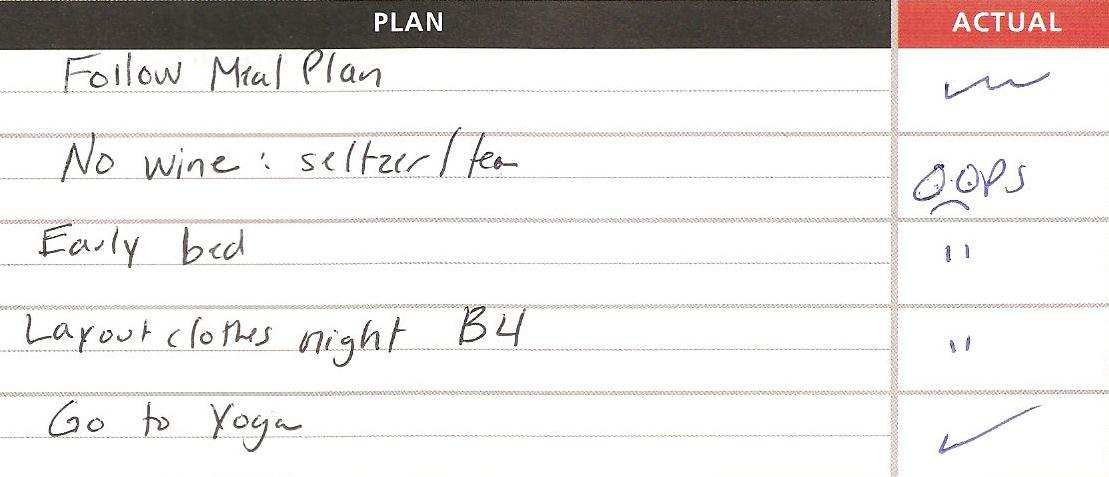
- I always thought, "I'm not an alcoholic...I'm not like them...I can control my drinking"...yet I never really could. Every time I started a health / fitness program and challenged myself to forgo booze until the weekend, I could not do it. Here are three separate days in a row from my 2005 fitness log:


I am very grateful to be 15 years sober on November 18, 2020. It was only through quitting drinking that I was able to heal my body and begin the long, long process of healing my mind and soul as well.
Chemical addiction does not go away without help, and will leave you empty, lonely, very sick, mentally ill, incarcerated, and / or dead. Please think about this - especiallyif you can relate to any of what I wrote. Seek assistance from a therapist or counselor. I promise that it is brighter on the other side - and waaaay more fun!!!
-------------------------------------------------------------------------------------------------------------------------
*Handouts from that first recovery center interview - taken from the Diagnostic & Statistical Manual of Mental Disorders, 4th Ed. Copyright 1994, American Psychiatric Association:


*UPDATE: The above sheets are a good overview of addiction symptoms vs. abuse symptoms; howeveer, keep in mind they are older diagnostic sheets; the DSM-V (the Diagnostic and Statistical Manual of Mental Disorders {5th revision} of the American Psychiatric Association) has since categorize symptoms and diagnosis a little differently.


