Showing posts with label addiction. Show all posts

Wednesday, October 4, 2017

up for air

Photo by Simon_sees
Exactly one week before my 51st birthday, five days before I fly again (another blog post entirely!), and coming up next month, the one year anniversary of my brother's death.

I'm rapidly becoming depressed (and anxious about flying). I know what to do, just struggling with the ability to even do.

You see, it's not as easy as it should be - simply knuckle down, "put on [my] 'Big Girl' panties", and apply all the other wellness tools about which I preach here and teach my peers on the job. If it were that easy for me, consider it done!

Rather, it's a weight bearing down - an invisible suit of lead. Or a cage - a dark tunnel with only a lit match to guide me out.

At one family night, back when I was in addiction treatment, another group member's wife was on the verge of tears, asking her husband, "I don't understand - why can't you just stop? You see what it's doing to you and our family." 

He had no answer for her, but I chimed in:

It's like being at a pool and watching all the other swimmers dive in and successfully swim the length of the pool while holding their breath. It's your turn. You think, 'Piece a cake.' You dive in and only a few meters out, you need to breath. You keep on going, saying to yourself, 'Knuckle down. Just do it. Everyone else did...'; but with every stroke, the urge to breath is stronger and stronger until it's so overwhelming you come up for air. You pop up, and everyone's disappointed in you. You're disappointed in you. 

So you try again...and again...and again, and every time it's the same. In fact, the more you try, the shorter the distance before you need to breathe."  

And that's the way it is too with depression, although not so much an urge to do something, rather an inability to do the very thing(s) that will help.


The need to do something (addiction) or inability to do something (depression) is so ingrained in your wiring, it's almost fully unconscious. It's like the urgent drive to patch the hole with your finger before the dam bursts, or the instinct to seek cover from the hailing storm. You just do it, all the while maintaining the face of "normal" to the rest of the world. You mask you're illness until the disparity between your inside and the outside becomes too great and you explode or implode.

Often, the only way out, is to learn to breath with an instructor, and it can't be family. Most of the time, it can't even be friends. Sometimes the only way out is to leap into the arms of a professional and trust that they'll guide you eventually to the other side of the pool.

So, I guess I just solved my own dilemma. Calling my therapist today.


Sunday, November 13, 2016

Brain Cancer Sucks


Dear Readers:

A million and ten times over the last year I said I was getting back to blogging, but never 
did. As I mentioned at one point in a previous post, I've been going through some emotionally trying times with a suffering loved one. [See Pat Clarke - written by his best friend, my husband Greg.] Though it consumed me and I desperately wanted to write about it, I also didn't want to share too much out of respect for his privacy - until now.

My brother is dying of Gliomatosis Cerebri - one of the rarest forms of brain cancer. {God! I've never used that verb before when referring to his illness!}

As you may well know, staying out of the Vortex of major depression and addiction has been (and always will be) a constant battle. This past year, however, tested the strength of my recovery more than any other time in my life thus far. So now more than ever, I need to return to blogging as cathartic therapy. I'll share with you what I've been learning as I've walked (and still walk) this long, hard journey with my little brother. 

Additionally, as soon as possible, I'll be updating to a new blog site and expanding the content to include a broader range of topics such as: brain cancer, grief, and more of an emphasis on maintaining mental wellness in general.

That's all I've got energy for now. Have a happy and healthy week! 

Love, 

Karen


Wednesday, October 7, 2015

READ THIS BLOG POST - IF NO OTHER!!!!

Well it's official folks. I am depressed...


...again. 

I'm writing this as one of the first steps towards turning things around. Writing is therapeutic and can help one unleash pent-up emotions, problem solve, and get motivated, refocused, and recommitted.

You see, as I've mentioned a lot lately, I'm so DONE with chemical addiction. In the past three months, it's plowed through the lives of several people I know and love, leaving damaged relationships, incarceration, insanity, and death in its wake. And now, yet another individual I know and love is hospitalized and undergoing tests for a potentially life threatening illness that's very likely caused by addiction.

I'm exhausted, spent, and feeling defeated. 


But you can help, DEAR READER!!

If you even remotely suspect you may be abusing alcohol or drugs or have an addiction...

and/or...

If you will not or cannot drink less than the recommended daily or weekly allowance of alcohol...

and/or...
Art therapy from my treatment. 2005

If any of the Pink Hi-Top Adventures' posts below rings true for you...

please, PLEASE, PLEASE!!! at very least check out the resources below AND make an appointment with an addiction professional. (I say "addiction professional" because the medical and psychological professions' knowledge of addiction diagnosis and treatment is scanty at best.) 

And for the love of God, please keep in mind you do not have to "check in" just because you are having an interview. Legally, it's entirely up to you. You won't be kidnapped, drugged, or coerced. It's not a cult.

And contrary to what many addicts tell themselves, aside from treatment centers for the rich and famous, addiction treatment specialists and centers do not make a boat load of money. They do it for the love of others and the HATE of the disease. Besides, they don't need you. Believe me, there are more than enough people out there to fill the beds. 

Speaking of money. By law, insurance companies are now required to cover at least some of the cost. In addition, most treatment centers are happy to assist you in coming up with a manageable payment plan. They know that addicts are notoriously bad about personal finance and may well have low-paying jobs, legal expenses, been fired, or lost a supporting partner. And besides, the interview is frickin' FREE!

The only thing that will happen to you in having an interview with an addiction professional is self-knowledge and peace of mind. YOU HAVE NOTHING TO LOSE!! If you don't have an addiction to drugs or alcohol, then you can go on your merry way. If on the other hand, you discover you haven an addiction, YOU HAVE EVERYTHING TO GAIN - energy, relationships, health, hope, and LIFE!!

So...

               for the love of God...


DO IT, DAMN IT, DO IT!!

-----------------------------------------------------------------------------------------------------------------------

Before

National Council on Alcoholism and Drug Dependence (NCADD)
Pink Hi-Top Adventures:

After!

If you ever want to talk about any of this (or anything else,for that matter!), PLEEEEEEASE contact me at: 
pink.hi.tops@gmail.com.


Tuesday, September 29, 2015

Crossing the bridge, and letting go...

I have been very depressed over the last week. This time, it's not just brain chemistry. There's a legitimate reason in my life right now. I'm not at liberty to go into details, but suffice it to say, someone I know and care about is suffering from addiction and depression. 


I've done the best I can to support her, but I can only do so much. I know that I have to, as Alcoholics Anonymous says, "Let Go, Let God"; but that's easier said than done! The need to control outcomes is a difficult thing to...control!

I'd like to share an excerpt from a book of daily meditations from which I'm trying to draw inspiration from now: The Language of Letting Go, by Melody Beattie.* {A book I highly recommend for those in recovery of any kind, those who are co-dependent, and, well, everyone else!}

--------------------------------------------------------------------------------------------------------------------------

"Letting Go of Those Not in Recovery"  February 12

We can go forward with our life and recoveries, even though someone we love is not yet recovering. 

Picture a bridge. On one side of the bridge it is cold and dark. We stood there with others in the cold and darkness, doubled over in pain. Some of us developed an eating disorder to cope with the pain. Some drank; some used other drugs. Some of us lost control of our sexual behavior. Some of us obsessively focused on addicted people's pain to distract us from our own pain. Many of us did both: we developed an addictive behavior, and distracted ourselves by focusing on other addicted people. We did not know there was a bridge. We thought we were trapped on a cliff.

Then, some of us got lucky. Our eyes opened, by the Grace of God, because it was time. We saw the bridge. People told us what was on the other side: warmth, light, and healing from our pain. We could barely glimpse or imagine this, but we decided to start the trek across the bridge anyway.


We tried to convince the people around us on the cliff that there was a bridge to a better place, but they wouldn't listen. They couldn't see it; they couldn't believe. They were not ready for the journey. We decided to go alone, because we believed, and because people on the other side were cheering us onward. The closer we go to the other side, the more we could see, and feel, that what we had been promised was real. There was light, warmth, healing, and love. The other side was a better place.

But now there is a bridge between us and those on the other side. Sometimes, we may be tempted to go back  and drag them over with us, but it cannot be done. no one can be dragged or forced across the bridge. Each person must go at his or her own choice, when the time is right. Some will come; some will stay on the other side. The choice is not ours.

We can love them. We can wave to them. We can holler back and forth. We can cheer them on, as others have cheered and encouraged us. But we cannot make them come over with us. If our time has come to cross the bridge, or if we have already crossed and are standing in the light and warmth, we do not have to feel guilty. It is where we are meant to be. We do not have to go back to the dark cliff because another's time has not yet come.

The best thing we can do is stay in the light, because it reassures others that there is a better place. And if others ever do decide to cross the bridge, we will be there to cheer them on.

*Beattie, M. (1990). February. In The language of letting go (pp. 41-42). Center City, MN: Hazelden.

Saturday, April 18, 2015

Favorites

I periodically post this for new readers. If you've already heard this spiel, you may want to go check your news feed again, or search for funny videos of cats. But do stop by again soon!

For those of you who are new to this blog, here's an overview.

------------------------------------------------------------------------------------------------------------------------


Pink Hi-Top Adventures is my first blog ever. I started it back in January 2013 as a chronicle of my ongoing recovery from depression, anxiety, and alcoholism. 

About 9.5 years ago, I entered treatment for alcohol addiction. At the time, I thought it would resolve my issues and help me move forward in life; however, it only drained the pond and uncovered the disease lurking at the bottom.

I had been anxious and depressed but functioning for years, and about two years ago, I totally imploded. I spent three weeks in bed - unable to work, unable to shower, unable to function. My thoughts were turning darker too. I fantasized about death and hurting myself; and for the first time ever, it felt comforting and logical.

When I shared this with my {wonderful!} husband, he reached out to my therapist; and I was admitted to a partial hospitalization treatment program {PHP} immediately. There I was diagnosed with major depression, dysthymia {long-term, low-grade depression}, and generalized anxiety disorder. Fortunately, I was treated by wonderful doctors and therapists; and, though I've experienced periodic set-backs along the way, I've been doing better overall since.

This blog is a chronicle of my continuous recovery and progress toward achieving my goals - one of which is graduating from college with a psychology degree. {I've been in college on and off since September 1984; and finally graduating is quite the achievement for me!} I also hope to inspire and inform you, dear reader, with personal stories, resources, and a little humor!

The blog title is inspired by my favorite pair of Converse Chuck Taylor’s that I wore in my youth - when I last felt happy and free.

And finally, Pink Hi-Top Adventures is a place for you too. Please feel free to comment and discuss - either in the comments section of this blog, or on the blog's Facebook page!

Thanks for reading!

----------------------------------------------------------------------------------------------------------------------------------

Here is an index of some of my favorite posts:

ADD:


One Step at a Time (9/28/13)


Addiction:

The Anonymous People (9/14/14)
The Raging River (3/13/14)
Thoughts from my addiction (2/27/13)
Alcoholic or problem drinker? (3/14/13)
How do you help and addict (6/19/13)
Take me out to the ballgame! (8/12/13)


Anxiety:

Carousel in the Crazy House (4/12/15)
Thoughts (7/7/14)
Obstacles (5/22/13)
Social Anxiety (5/29/13)


Depression:

Depression (10/7/14)
Depression Sucks! (11/24/13)
Symptoms of Depression (10/28/13)
Notes from the Vortex (2/11/13)
Life (3/7/13)
Lifeline (3/8/13)
Grey veil...again?! (3/16/13)
Overcoming...inertia! (3/19/13)
Can't sleep (4/23/13)
Do the next right thing - part II (4/25/13)
The daily struggle (6/6/13)
Taking down the wall (6/7/13)
Contained emotions (6/13/13)


Schizophrenia:

Schizophrenia (10/9/14)


Stigma:

It IS an Illness (10/7/14)
Medication Stigma (4/29/14)
"Nervous breakdown" (3/6/13)
Depression is not a character defect (3/27/13)


Wellness:

Renew and Refresh (4/5/15)

New Hobby (10/3/14)
CBT (6/29/14)
Physical Wellness - Getting Back on Track (5/3/14)
Pet Therapy (3/24/14)
Coming Out! (3/14/14)
The 7 Habits of Mental Wellness (about Stephen Covey's, 7 Habits of Highly Effective People):
 - Introduction to (1/25/14)
 - Habit 1: Be Proactive (2/2/14)
 - Habit 2: Begin with the End in Mind (2/12/14)
 - Habit 3: Put First Things First (6/23/14)
Trip to Roanoke, Virginia:
 - Rain Clouds (10/12/13)
 - Roanoke (10/12/13)
 - Heading Home (10/14/13)
Never underestimate your own power! (2/26/13)
Acceptance (3/1/13)
Recovery step #2: sleep, damn it! (3/5/13)
Rebirth (3/30/13)
Wellness part I: physical (4/26/13)
Change is possible part II (6/27/13)
Seven steps to mental health (8/2/13)
Take me out to the ballgame! (8/12/13)
Climbing back up (8/18/13)


Tuesday, October 7, 2014

It IS an Illness

Originally posted 3/27/13:


I still struggle at times with the notion that depression, anxiety, and chemical addiction are physical diseases, and not just character defects. Recently, I had been doubting the disease model yet again, and was beating myself up about it. I suppose, though, this is part of denial -  a normal step in the course of change {more on that in another blog}. 

Then, it hit me: I know that what I have is a physical illness and that medication does in fact work for me because of the difference in my cognition / thinking when I am taking medication. 

Here's the supporting evidence:
  1. The incessant cycling of negative thoughts has stopped. It is not that I have no negative thoughts, sadness, or anger - that would not be normal - it's just that I don't dwell on these indefinitely.
  2. I like things again. No really, I'm serious. For at least two decades, not much appealed to me. I would do the things I know I should like, but everything at the banquet of life tasted like cardboard - the world was flat. I knew, for example, that horses, tennis, and time with family and friends should generate feelings of joy in me, but it was all....meh...take it or leave it...bland...grey - and at times even irritating.
  3. Color, color, C O L O R has returned to my life. Once again, I enjoy colors in objects, nature, and furnishings. My clothes, for example, have gone from neutrals to vibrant blues, purples, greens, and...P I N K. {I still adore black too!}
  4. I look forward to things. Yes, believe it or not, if nothing is scheduled on the horizon, I have actually created dates and outings in the past two months! I have reached out to female friends. This is the first time in a long time...no...this is the first time that I have ever done this! 
The fact that taking a physical pill does affect change in my thoughts and subsequent behaviors, speaks of a physical, underlying disease capable of responding to medication. And lest anyone confuse psychoactive prescription medication for opiates, let me underscore: the medication does not make me feel fantastic all the time. These are not "happy pills". The meds just simply permit me to feel the normal range of feelings that the average person is capable of feeling. They free me to be Me; and for that, I am truly grateful!

Saturday, September 13, 2014

The Anonymous People


The Substance Abuse and Mental Health Services Administration (SAMHSA) declared September 2014 to be Recovery Month. In honor of this, the club (of which I'm president ;) ), the Virginia Association of Addiction Professionals (VAAP) Student Chapter presented a screening of the documentary The Anonymous People followed by a panel discussion. 

The film is about the Catch 22 of recovery: to protect recovering people from the hurtful stigma attached to addiction, it is important to maintain anonymity; however, anonymity perpetuates the stigma!  

The movie presents the new, or rather, revived movement of people coming out openly and calling out addiction for the disease it is. It suggests we follow the example of HIV-AIDS patients who came out as a united front in the late 80s / early 90s and smashed the myths about their disease with honesty and openness. Just as they declared, "Silence = Death", it is important for addicts to educate the public openly and unite against the stigmas that prevent millions from getting help.

This is one of the reasons I blog about my addiction, as well as my mental illness: to shine light on the darkness, to help those suffering feel less alone, and to encourage others to speak their truth as well.

If you are an addict, someone suffering from mental illness, a family member or friend, or just someone interested in positive change, the film is a must see! It is available to rent or own on Amazon Instant Video. Check it out!


Thursday, June 19, 2014

Alcoholic or Problem Drinker?

{Re-post from 3/14/13.}

I'm often asked how it was that I knew I was an alcoholic when I first quit drinking. After all, I wasn't exactly the image most people have in their heads when they think "addict". I wasn't an angry drunk - I never beat my children. I held down a job. I didn't drink early in the day or in the morning. I didn't drink in bars - didn't do "happy hour". I didn't hide my wine - in fact I reveled in the notion that I was a connoisseur {or so I fancied myself.}

Me with my Ex...and a perm! - hey, it was the mid-90s!
But I did spend my adult life trying to pound a square peg into a round hole. I wanted to drink as I pleased AND be a happy, healthy, fit, confident, successful woman...but it wasn't working. 

In my mid-30s, I began to see a therapist for panic attacks, anxiety, and low self-esteem. I thought I'd be able to root up some childhood trauma, hold it up to the light of reason, and watch my anxiety turn to dust like a vampire at dawn. Instead, I began the long journey of peeling away the layers to expose the diseases within. 

Apparently, my therapist suspected a substance abuse problem early on. She challenged me on several occasions to forgo the drink, but I could never follow through with the commitment. In fact, though I heard her most of the time, I repressed her words almost instantly.

Finally, after failing yet another self-control challenge, I agreed to at least be evaluated by a substance abuse counselor. I thought I could finally put the discussion to rest, learn how to drink modestly, and continue my "hobby". 

The counselor asked several questions, and at the end of the evaluation, told me he thought I had an addiction. I looked at him dumbfounded, so he handed me a sheet with the definitions of abuser vs. addict to see what I thought. {See bottom of post.} I was certain that I was an abuser and simply needed help getting back on track with "healthy drinking" - after all, wasn't I doing myself a favor in choosing red wine over beer? 

First, I read the traits of abuse and could relate to most. Then, it all came crashing down when I read through addiction -  my eyes filled with unstoppable tears. The divorce proceedings had begun.

In early outpatient treatment, much of my "work" was spent examining the evidence that I was not a normal drinker. Diagnosis buy-in {admitting I had a problem} was step one.

Over the next few weeks, the evidence mounted. I'll share with you some of what I revealed to myself - in no particular order. I knew I was an alcoholic, because: 
  • I felt uncomfortable, nay, damn irritable at parties, weddings, or other events at which no alcohol was served; and I would limit time spent there.
  • And if I knew in advance that alcohol was not on the menu at the occasion, I would drink before and after.
  • I drank everyday - my dose was 1 - 3 glasses of red wine.
  • At special occasions {i.e., parties, weddings, funerals, holidays, Fridays, Saturdays...} I drank as much as I pleased. 
  • I could almost always drink more than any other {non-alcoholic} woman - and many men - a point in which I took great pride.
  • I felt uncomfortable and cranky almost nightly when my husband wouldn't have a drink with me at dinner.
  • If given the choice of food or wine at a party, I chose wine first.
  • I could never understand how some people can have just 1 or 2 drinks or leave behind a half-full glass. It made me uncomfortable and gnawed at my core.
  • If my husband or I went out to dinner and the place we chose had no alcohol on the menu, I would be irritable and bitch about finding another restaurant.
  • My dresser and night stand were littered with wine glasses almost all the time.
  • My kitchen decor was a grapes / wine motif.
  • If I thought, for example, that a piece of chicken I ate was a little too pink inside, I would take a shot of Stoli {vodka} that I kept in the freezer - to kill any salmonella bacteria I may have ingested, you see.
  • If the weather forecast called for a possible hurricane or snowstorm, the first mental planning I did was an assessment of how much wine I had left, and how much I should pick up - forget the bread, milk, eggs, bottled water, and batteries that everyone else foolishly stocked up on!
  • Every day on my ride home, my thoughts would turn to how much wine I had in the house, and whether or not I needed to pick up any.
  • Once we were invited to the wedding of a good friend; and it was held at a vineyard. Since it was a weekend wedding extravaganza, we rented a house with our other friends who enjoyed drinking as much as I did. So...I brought five bottles of pricey red wine to have on hand. I kept my stash in the car, however, since I didn't want anyone else drinking it. It was back-up. Just in case my drinking buddies ran out of booze. At a vineyard.
  • I had rules around my drinking, e.g., "I don't drink before the evening", "I only drink 1 - 3 glasses on week nights", "I only {mostly} drink red wine - it is healthy for the heart and prevents cancer", "I don't hang out in bars, unless it's a special occasion", "I don't drink and drive" {unless I have to...}, "I don't drink hard liquor" {unless I ate under-cooked meat, or unless there's nothing else to drink!}, "I don't hide my wine - only alcoholics hide their booze. Please note - normal drinkers do not need rules.
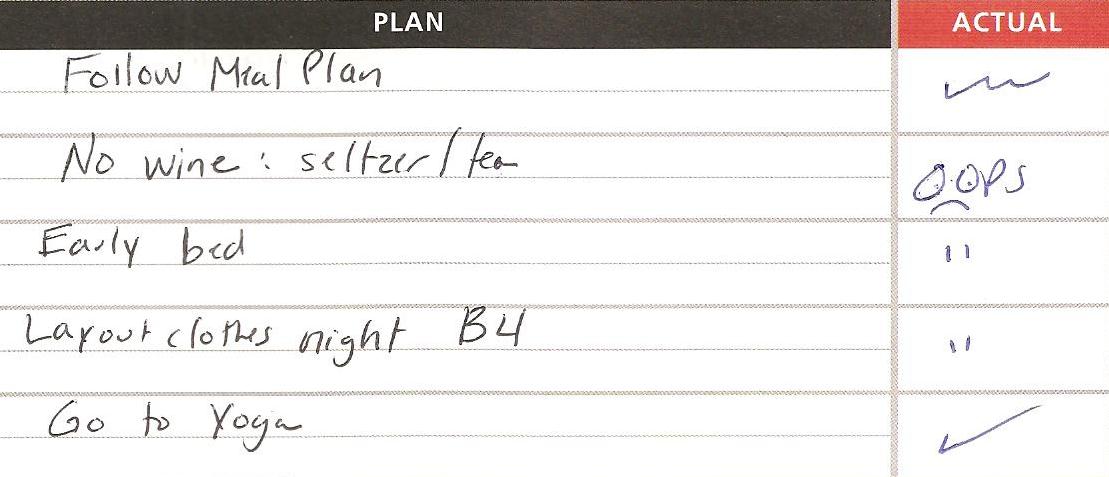
  • I always thought, "I'm not an alcoholic...I'm not like them...I can control my drinking"...yet I never really could. Every time I started a health / fitness program and challenged myself to forgo booze until the weekend, I could not do it. Here are three days in a row from my 2005 fitness log: 
 

I am very grateful to be 10 years sober now (come November 18, 2015). It was only through quitting drinking that I was able to heal my body and begin the long process of healing my mind and soul.

Chemical addiction does not go away without help, and will leave you empty, lonely, very sick, insane, incarcerated, and / or dead. Please think about this if you can relate to any of what I wrote. Seek assistance from a therapist or counselor. I promise that it is brighter on the other side - and waaaay more fun!!!

-------------------------------------------------------------------------------------------------------------------------------
*Handouts from that first recovery center interview - taken from the Diagnostic & Statistical Manual of Mental Disorders, 4th Ed. Copyright 1994, American Psychiatric Association:


*UPDATE: The above sheets are a good overview of addiction symptoms vs. abuse symptoms; howeveer, keep in mind they are older diagnostic sheets; the DSM-V (the Diagnostic and Statistical Manual of Mental Disorders {5th revision} of the American Psychiatric Association) has since categorize symptoms and diagnosis a little differently.

Friday, April 25, 2014

My First Speech

Hi all! Sorry...yet again...that I haven't blogged in a while! I have been crazy busy with school. One of the things that I did this week, was participate in a panel discussion about my journey to and through NOVA (my college).

Thought I'd share with you the spiel I gave since it is about my mental health and addiction journey:

My name is Karen Clarke. My journey to and through NOVA is a rather convoluted one. It all began in 1988 – back when NOVA was still on the quarter system! I had just partied myself out of another college, and NOVA was there to catch me.

My first two semesters here went rather well. I had all A’s, and I met my best friend. Then I became pregnant. As a single mom, I quit school and went to work.

I did not entirely give up on the college dream, though. On and off for the next ten years (more off than on) I took a class here and there. My grades, however, were a mixed bag. I either had an A, a W, or an F – much like my grades at my previous college. I had always been a bright underachiever. My A’s were from times when I made it through an entire semester. My W’s were from withdrawing, and my F’s were from failing to withdraw – rather than earned Fs.

Meanwhile, I was job hopping as well. I never spent more than two years in a job. Like my courses, I had always struggled with attendance. When I was on the job, or in class, I was an outstanding employee or student. There were many days, however, when I simply could not get out of bed and face the day; so I would call in sick or skip class.

In 2000, I quit yet another job and returned to school full-time. This time, I managed to do well enough to transfer into George Mason. Life was good. I had an internship at the Smithsonian’s paleobiology lab through my NOVA geology professor, and my grades were great.

Shortly after transferring to Mason in the fall of 2001, things fell apart. September 11 struck; and I found myself on campus so anxious that there would be a terrorist attack – GMU being a large campus in the shadow of Washington. I had always been anxious, though – sitting by the door in all my classes just in case I had to leave, but this was more anxiety than I had ever felt. I also began having panic attacks.

After three semesters of the A, W, F cycle, I was academically suspended from Mason.
I went back to work, but I was miserable. Having panic attacks, the bright underachiever stuck in a dead-end job, unable to do the things I claimed I wanted.

That is when I realized I was incapable of helping myself – that I needed help.

I began seeing a therapist in 2004. I thought I’d be able to quickly root up some childhood incident, disable it, and begin living the life I’d always dreamed.

But it wasn’t quite that simple.

Early on, my therapist began questioning my drinking habits. I tuned it out for the most part – after all, I didn’t have a problem. I was a wine aficionado – not an alcoholic. I never drank before five. I never drank on the job. Never beat my children. I held many volunteer positions – Girl Scouts, PTA – and never drank during those. I just knew the difference between a smooth Merlot and a robust Pinot Noir.

But I had to admit – the panic attacks continued - that nagging, constant anxiety was there. And there was the repeat absenteeism at work and in class. Oh, and my 5 year old saying to me in Giant one day, “boy Mommy, you sure do love wine!” as she glanced over the basket filled with bottles.

Finally in the fall of 2005, I agreed to go to a treatment center for an assessment. After all, I was sure they would tell me I was an abuser – not an addict – and they would teach me how to drink safely.
Well, it didn’t work out that way. I discovered that I was indeed an alcoholic. I entered outpatient treatment in November and it was one of the best things to happen to me.

I thought for sure this time I had hit the nail on the head – that this was the thing that was stopping me up…but it wasn’t.

Though the panic attacks were gone, the absenteeism continued…A…W…F…I remained in therapy, but nothing was changing.

Fast forward to August 2012. My family and I had just returned from a relaxing vacation in Wyoming. My husband and daughter were rested, refreshed, and glad to be home. I was uptight, anxious, and dreaded returning to the stress pit of Washington.

I felt trapped in my life. I was at the end of my rope with myself. I was beginning to think that at age 45, I was not going to change. That I was beyond help. After all, I had been in therapy for 8 years!
Feeling helpless and trapped, I began having fantasies about flying off my DC office building – about what it would feel like to jump onto the Metro tracks. I finally confessed this to my husband because I didn’t trust myself; and I didn’t want to emotionally scar a Metro driver or hurt any passengers. 

That night, I went to the Inova ER. Two days later I was in partial hospitalization – PHP. There I was diagnosed with major depression, generalized anxiety disorder, and dysthymia (long term, low grade depression). This too was one of the best things that ever happened to me. I spent a month there, and while I was there, began rethinking my career goals. Much like I was at the recovery center, I found myself in group listening and speaking as a patient and paying attention to the group dynamics. There was one patient in particular who never talked – no matter how they tried to draw her in. I reached out to her though, and one day on break she opened up to me. After that, she participated in group like the rest of us. This incident was pivotal.

For the first time, I began to see my life experience, not as wasted years, but as on-the-job training. I realized then and there that my calling was to be a therapist. I wanted to give back what I had been given in recovery and at PHP.

I quit my job in May 2013, and returned to NOVA full time. I will be graduating this spring with my AS, Social Science, psychology and will be receiving a Substance Abuse Counseling Certificate in December.

NOVA has been a God-send. No matter where I was in the journey, I was always able to turn to NOVA to reinvent.


My goals for the future? To be a psychologist working with dual-diagnosis patients – those with addiction and underlying mental health disorders and I hope to one day open my own wellness center.

Friday, March 14, 2014

Coming Out!


A friend who also suffers from depression recently told me how amazed she is that I am able to share so openly and publicly about my illnesses. Well, this is why I do it:

1. To help those suffering from mental illness feel less alone;

2. To enlighten the loved ones, friends, family, colleagues, and caregivers of those suffering about what it feels like for someone with mental illness; 

and perhaps most importantly, 

3. To normalize mental illness as the biopsychosocial disease it is.

Number 3 is particularly important because for so long those suffering from various mental illnesses (which includes addiction) have suffered in the shadows. For fear of the stigma attached to mental illness and addiction, many have gone untreated and misunderstood rather than seek professional help.

The image we often hold of the alcoholic or the addict is not a particularly nice one: brown paper bags, dirty streets and alleys, wife beaters, drunk drivers, the dissatisfied house frau drinking her woes away with a martini in the afternoon while her baby cries unattended. Ask anyone in AA why the first step is so darned difficult yet powerful to take - saying, I'm an alcoholic. 

The image conjured up by the words mentally ill is no better: straight jackets, padded rooms, Nurse Ratched...

But, having depression, anxiety disorder, substance use disorder, bipolar disorder, schizophrenia, post-partum depression, etc. is not a character defect. They are brain diseases like diabetes is a metabolic disease or asthma is a respiratory disease. 

I am not ashamed to say in public, "I have asthma and I have to carry an inhaler." Nor should I be ashamed to say, "I am an alcoholic with depression and anxiety disorder and I carry my Where and When*."  

So that is why. The more of us that come out and say in a matter-of-fact way, e.g., I am an addict or I have bipolar disorder, the more we normalize mental illness and help it to be seen for what it is, and the more we help those who need it!


*Little book of Alcoholics Anonymous that lists local meetings - places, days, and times.


Thursday, March 13, 2014

The Raging River

I woke up this morning with the image of a glass of garnet colored wine in my mind. I could taste it on my tongue; I could smell the earthy cork...

Then I caught myself. Even eight years into recovery, I occasionally get a reminder that the gremlin is still alive and well deep inside me, just waiting for me to slip up. Just one drop on the tongue and the ground beneath me could crumble. 

Well, relapse isn't quite that simple. It comes much earlier than the actual drink, pill, shot, or smoke. Relapse begins when we fail to attend to our recovery on a daily basis.

My recovery counselor said that we are always relapsing; and he shared a great metaphor with us: Envision a raging river leading up to a waterfall. The river is the power of our addiction; and in order to maintain recovery, we must always be rowing upstream. The moment we stop, we slip closer to the waterfall. The waterfall, however, is the act of drinking, e.g., though, and not the relapse. The relapse occurs much earlier - somewhere in the rapids. The question we must always ask ourselves is how close are we to the edge. If we are too close, we better start rowing!

What do we do to row and get further upstream? Here are some ideas:

  • Go to a meeting (AA, NA, GA, any support group)
  • Tell someone who understands and is familiar with your addiction. Heck, if you have no one, contact me! pink.hi.tops@gmail.com  I'd be happy to chat with you!!
  • Get that bloody 8 hours of sleep a night!!! 
  • Limit the simple sugars in your diet. Eat a protein- / complex carb-balanced diet which includes lots of vegetables and fruits.
  • Drink half your body weight (pounds) in ounces of water.
  • Exercise - especially aerobic (e.g., running, walking, Zumba, aerobics, cycling).
  • Pour yourself into a hobby.
  • Read something inspiring.
  • Laugh! Watch a comedy (preferably not Cheech and Chong's Up in Smoke...)
  • Get out into nature: Touch and feel the bark on a tree! Smell a flower! Look at the beautiful waterfalls and feel the spray on your face. Listen to the sounds of the waves crashing on the shore and the seagulls screeching above. Look up into the night sky and count the number of satellites you see. You get the picture...
  • Connect with an animal. Dogs, cats, horses, and other pets are wonderful therapists!
  • Now that I think about it, connect with your therapist; and if you don't have one, get one.

So now that I've had that dream, where am I on the river? How close am I to the falls? Which of the above am I going to do today to keep myself rowing?