Showing posts with label alcoholism. Show all posts

Sunday, November 13, 2016

Brain Cancer Sucks


Dear Readers:

A million and ten times over the last year I said I was getting back to blogging, but never 
did. As I mentioned at one point in a previous post, I've been going through some emotionally trying times with a suffering loved one. [See Pat Clarke - written by his best friend, my husband Greg.] Though it consumed me and I desperately wanted to write about it, I also didn't want to share too much out of respect for his privacy - until now.

My brother is dying of Gliomatosis Cerebri - one of the rarest forms of brain cancer. {God! I've never used that verb before when referring to his illness!}

As you may well know, staying out of the Vortex of major depression and addiction has been (and always will be) a constant battle. This past year, however, tested the strength of my recovery more than any other time in my life thus far. So now more than ever, I need to return to blogging as cathartic therapy. I'll share with you what I've been learning as I've walked (and still walk) this long, hard journey with my little brother. 

Additionally, as soon as possible, I'll be updating to a new blog site and expanding the content to include a broader range of topics such as: brain cancer, grief, and more of an emphasis on maintaining mental wellness in general.

That's all I've got energy for now. Have a happy and healthy week! 

Love, 

Karen


Wednesday, October 14, 2015

Alcoholic or problem drinker?

{Re-post from 3/14/13 - especially for my friends who have been trying to quit and/or questioning their own drinking habits.}

-------------------------------------------------------------------------------------------------------------------------

I'm often asked how it was that I knew I was an alcoholic when I first quit drinking. After all, I wasn't exactly the image most people have in their heads when they think "addict". I wasn't an angry drunk - I never beat my children. I held down a job. I didn't drink early in the day or in the morning. I didn't drink in bars - didn't do "happy hour". I didn't hide my wine - in fact I reveled in the notion that I was a connoisseur {or so I fancied myself.}

Me with my Ex...and a perm! - hey, it was the mid-90s!
But I did spend my adult life trying to pound a square peg into a round hole. I wanted to drink as I pleased AND be a happy, healthy, fit, confident, successful woman...but it wasn't working. 

In my mid-30s, I began to see a therapist for panic attacks, anxiety, and low self-esteem. I thought I'd be able to root up some childhood trauma, hold it up to the light of reason, and watch my anxiety turn to dust like a vampire at dawn. Instead, I began the long journey of peeling away the layers to expose the diseases within. 

Apparently, my therapist suspected a substance abuse problem early on. She challenged me on several occasions to forgo the drink, but I could never follow through with the commitment. In fact, though I heard her most of the time, I repressed her words almost instantly.

Finally, after failing yet another self-control challenge, I agreed to at least be evaluated by a substance abuse counselor. I thought I could finally put the discussion to rest, learn how to drink modestly, and continue my "hobby". 

The counselor asked several questions, and at the end of the evaluation, told me he thought I had an addiction. I looked at him dumbfounded, so he handed me a sheet with the definitions of abuser vs. addict to see what I thought. {See bottom of post.} I was certain that I was an abuser and simply needed help getting back on track with "healthy drinking" - after all, wasn't I doing myself a favor in choosing red wine over beer? 

First, I read the traits of abuse and could relate to most. Then, it all came crashing down when I read through addiction -  my eyes filled with unstoppable tears. The divorce proceedings had begun.

In early outpatient treatment, much of my "work" was spent examining the evidence that I was not a normal drinker. Diagnosis buy-in {admitting I had a problem} was step one.

Over the next few weeks, the evidence mounted. I'll share with you some of what I revealed to myself - in no particular order. I knew I was an alcoholic, because: 
  • I felt uncomfortable, nay, damn irritable at parties, weddings, or other events at which no alcohol was served; and I would limit time spent there.
  • And if I knew in advance that alcohol was not on the menu at the occasion, I would drink before and after.
  • I drank everyday - my dose was 1 - 3 glasses of red wine.
  • At special occasions {i.e., parties, weddings, funerals, holidays, Fridays, Saturdays...} I drank as much as I pleased. 
  • I could almost always drink more than any other {non-alcoholic} woman - and many men - a point in which I took great pride.
  • I felt uncomfortable and cranky almost nightly when my husband wouldn't have a drink with me at dinner.
  • If given the choice of food or wine at a party, I chose wine first.
  • I could never understand how some people can have just 1 or 2 drinks or leave behind a half-full glass. It made me uncomfortable and gnawed at my core.
  • If my husband or I went out to dinner and the place we chose had no alcohol on the menu, I would be irritable and bitch about finding another restaurant.
  • My dresser and night stand were littered with wine glasses almost all the time.
    ©Jenny Ondioline
  • My kitchen decor was a grapes / wine motif.
  • If I thought, for example, that a piece of chicken I ate was a little too pink inside, I would take a shot of Stoli {vodka} that I kept in the freezer - to kill any salmonella bacteria I may have ingested, you see.
  • If the weather forecast called for a possible hurricane or snowstorm, the first mental planning I did was an assessment of how much wine I had left, and how much I should pick up - forget the bread, milk, eggs, bottled water, and batteries that everyone else foolishly stocked up on!
  • Every day on my ride home, my thoughts would turn to how much wine I had in the house, and whether or not I needed to pick up any.
  • Once we were invited to the wedding of a good friend; and it was held at a vineyard. Since it was a weekend wedding extravaganza, we rented a house with our other friends who enjoyed drinking as much as I did. So...I brought five bottles of pricey red wine to have on hand. I kept my stash in the car, however, since I didn't want anyone else drinking it. It was back-up. Just in case my drinking buddies ran out of booze. At a vineyard.
  • I had rules around my drinking, e.g., "I don't drink before the evening", "I only drink 1 - 3 glasses on week nights", "I only {mostly} drink red wine - it is healthy for the heart and prevents cancer", "I don't hang out in bars, unless it's a special occasion", "I don't drink and drive" {unless I have to...}, "I don't drink hard liquor" {unless I ate under-cooked meat, or unless there's nothing else to drink!}, "I don't hide my wine - only alcoholics hide their booze. Please note - normal drinkers do not need rules.
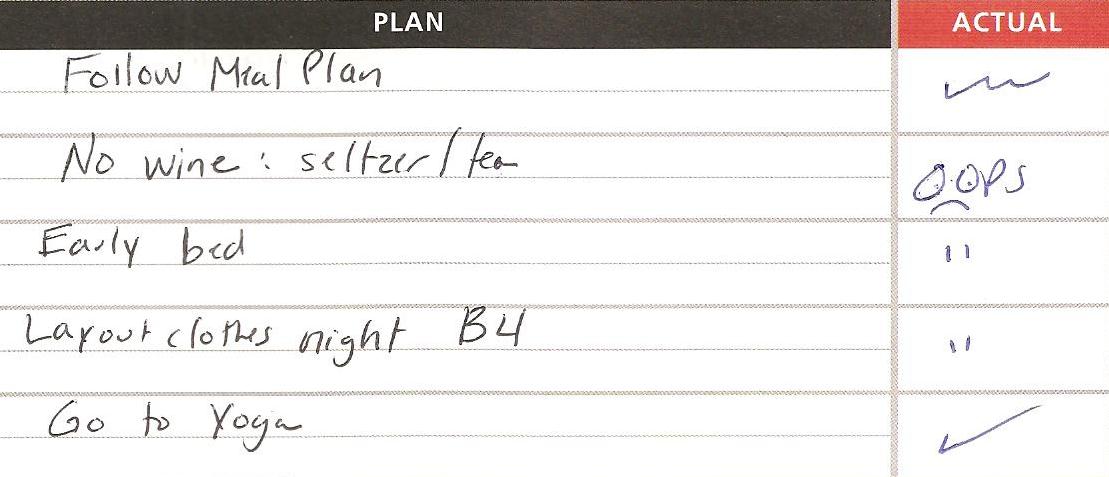
  • I always thought, "I'm not an alcoholic...I'm not like them...I can control my drinking"...yet I never really could. Every time I started a health / fitness program and challenged myself to forgo booze until the weekend, I could not do it. Here are three days in a row from my 2005 fitness log: 
 

I am very grateful to be 10 years sober now (come November 18, 2015). It was only through quitting drinking that I was able to heal my body and begin the long process of healing my mind and soul.

Chemical addiction does not go away without help, and will leave you empty, lonely, very sick, insane, incarcerated, and / or dead. Please think about this if you can relate to any of what I wrote. Seek assistance from a therapist or counselor. I promise that it is brighter on the other side - and waaaay more fun!!!

-------------------------------------------------------------------------------------------------------------------------
*Handouts from that first recovery center interview - taken from the Diagnostic & Statistical Manual of Mental Disorders, 4th Ed. Copyright 1994, American Psychiatric Association:


*UPDATE: The above sheets are a good overview of addiction symptoms vs. abuse symptoms; howeveer, keep in mind they are older diagnostic sheets; the DSM-V (the Diagnostic and Statistical Manual of Mental Disorders {5th revision} of the American Psychiatric Association) has since categorize symptoms and diagnosis a little differently.

Wednesday, October 7, 2015

READ THIS BLOG POST - IF NO OTHER!!!!

Well it's official folks. I am depressed...


...again. 

I'm writing this as one of the first steps towards turning things around. Writing is therapeutic and can help one unleash pent-up emotions, problem solve, and get motivated, refocused, and recommitted.

You see, as I've mentioned a lot lately, I'm so DONE with chemical addiction. In the past three months, it's plowed through the lives of several people I know and love, leaving damaged relationships, incarceration, insanity, and death in its wake. And now, yet another individual I know and love is hospitalized and undergoing tests for a potentially life threatening illness that's very likely caused by addiction.

I'm exhausted, spent, and feeling defeated. 


But you can help, DEAR READER!!

If you even remotely suspect you may be abusing alcohol or drugs or have an addiction...

and/or...

If you will not or cannot drink less than the recommended daily or weekly allowance of alcohol...

and/or...
Art therapy from my treatment. 2005

If any of the Pink Hi-Top Adventures' posts below rings true for you...

please, PLEASE, PLEASE!!! at very least check out the resources below AND make an appointment with an addiction professional. (I say "addiction professional" because the medical and psychological professions' knowledge of addiction diagnosis and treatment is scanty at best.) 

And for the love of God, please keep in mind you do not have to "check in" just because you are having an interview. Legally, it's entirely up to you. You won't be kidnapped, drugged, or coerced. It's not a cult.

And contrary to what many addicts tell themselves, aside from treatment centers for the rich and famous, addiction treatment specialists and centers do not make a boat load of money. They do it for the love of others and the HATE of the disease. Besides, they don't need you. Believe me, there are more than enough people out there to fill the beds. 

Speaking of money. By law, insurance companies are now required to cover at least some of the cost. In addition, most treatment centers are happy to assist you in coming up with a manageable payment plan. They know that addicts are notoriously bad about personal finance and may well have low-paying jobs, legal expenses, been fired, or lost a supporting partner. And besides, the interview is frickin' FREE!

The only thing that will happen to you in having an interview with an addiction professional is self-knowledge and peace of mind. YOU HAVE NOTHING TO LOSE!! If you don't have an addiction to drugs or alcohol, then you can go on your merry way. If on the other hand, you discover you haven an addiction, YOU HAVE EVERYTHING TO GAIN - energy, relationships, health, hope, and LIFE!!

So...

               for the love of God...


DO IT, DAMN IT, DO IT!!

-----------------------------------------------------------------------------------------------------------------------

Before

National Council on Alcoholism and Drug Dependence (NCADD)
Pink Hi-Top Adventures:

After!

If you ever want to talk about any of this (or anything else,for that matter!), PLEEEEEEASE contact me at: 
pink.hi.tops@gmail.com.


Saturday, September 13, 2014

The Anonymous People


The Substance Abuse and Mental Health Services Administration (SAMHSA) declared September 2014 to be Recovery Month. In honor of this, the club (of which I'm president ;) ), the Virginia Association of Addiction Professionals (VAAP) Student Chapter presented a screening of the documentary The Anonymous People followed by a panel discussion. 

The film is about the Catch 22 of recovery: to protect recovering people from the hurtful stigma attached to addiction, it is important to maintain anonymity; however, anonymity perpetuates the stigma!  

The movie presents the new, or rather, revived movement of people coming out openly and calling out addiction for the disease it is. It suggests we follow the example of HIV-AIDS patients who came out as a united front in the late 80s / early 90s and smashed the myths about their disease with honesty and openness. Just as they declared, "Silence = Death", it is important for addicts to educate the public openly and unite against the stigmas that prevent millions from getting help.

This is one of the reasons I blog about my addiction, as well as my mental illness: to shine light on the darkness, to help those suffering feel less alone, and to encourage others to speak their truth as well.

If you are an addict, someone suffering from mental illness, a family member or friend, or just someone interested in positive change, the film is a must see! It is available to rent or own on Amazon Instant Video. Check it out!


Thursday, June 19, 2014

Alcoholic or Problem Drinker?

{Re-post from 3/14/13.}

I'm often asked how it was that I knew I was an alcoholic when I first quit drinking. After all, I wasn't exactly the image most people have in their heads when they think "addict". I wasn't an angry drunk - I never beat my children. I held down a job. I didn't drink early in the day or in the morning. I didn't drink in bars - didn't do "happy hour". I didn't hide my wine - in fact I reveled in the notion that I was a connoisseur {or so I fancied myself.}

Me with my Ex...and a perm! - hey, it was the mid-90s!
But I did spend my adult life trying to pound a square peg into a round hole. I wanted to drink as I pleased AND be a happy, healthy, fit, confident, successful woman...but it wasn't working. 

In my mid-30s, I began to see a therapist for panic attacks, anxiety, and low self-esteem. I thought I'd be able to root up some childhood trauma, hold it up to the light of reason, and watch my anxiety turn to dust like a vampire at dawn. Instead, I began the long journey of peeling away the layers to expose the diseases within. 

Apparently, my therapist suspected a substance abuse problem early on. She challenged me on several occasions to forgo the drink, but I could never follow through with the commitment. In fact, though I heard her most of the time, I repressed her words almost instantly.

Finally, after failing yet another self-control challenge, I agreed to at least be evaluated by a substance abuse counselor. I thought I could finally put the discussion to rest, learn how to drink modestly, and continue my "hobby". 

The counselor asked several questions, and at the end of the evaluation, told me he thought I had an addiction. I looked at him dumbfounded, so he handed me a sheet with the definitions of abuser vs. addict to see what I thought. {See bottom of post.} I was certain that I was an abuser and simply needed help getting back on track with "healthy drinking" - after all, wasn't I doing myself a favor in choosing red wine over beer? 

First, I read the traits of abuse and could relate to most. Then, it all came crashing down when I read through addiction -  my eyes filled with unstoppable tears. The divorce proceedings had begun.

In early outpatient treatment, much of my "work" was spent examining the evidence that I was not a normal drinker. Diagnosis buy-in {admitting I had a problem} was step one.

Over the next few weeks, the evidence mounted. I'll share with you some of what I revealed to myself - in no particular order. I knew I was an alcoholic, because: 
  • I felt uncomfortable, nay, damn irritable at parties, weddings, or other events at which no alcohol was served; and I would limit time spent there.
  • And if I knew in advance that alcohol was not on the menu at the occasion, I would drink before and after.
  • I drank everyday - my dose was 1 - 3 glasses of red wine.
  • At special occasions {i.e., parties, weddings, funerals, holidays, Fridays, Saturdays...} I drank as much as I pleased. 
  • I could almost always drink more than any other {non-alcoholic} woman - and many men - a point in which I took great pride.
  • I felt uncomfortable and cranky almost nightly when my husband wouldn't have a drink with me at dinner.
  • If given the choice of food or wine at a party, I chose wine first.
  • I could never understand how some people can have just 1 or 2 drinks or leave behind a half-full glass. It made me uncomfortable and gnawed at my core.
  • If my husband or I went out to dinner and the place we chose had no alcohol on the menu, I would be irritable and bitch about finding another restaurant.
  • My dresser and night stand were littered with wine glasses almost all the time.
  • My kitchen decor was a grapes / wine motif.
  • If I thought, for example, that a piece of chicken I ate was a little too pink inside, I would take a shot of Stoli {vodka} that I kept in the freezer - to kill any salmonella bacteria I may have ingested, you see.
  • If the weather forecast called for a possible hurricane or snowstorm, the first mental planning I did was an assessment of how much wine I had left, and how much I should pick up - forget the bread, milk, eggs, bottled water, and batteries that everyone else foolishly stocked up on!
  • Every day on my ride home, my thoughts would turn to how much wine I had in the house, and whether or not I needed to pick up any.
  • Once we were invited to the wedding of a good friend; and it was held at a vineyard. Since it was a weekend wedding extravaganza, we rented a house with our other friends who enjoyed drinking as much as I did. So...I brought five bottles of pricey red wine to have on hand. I kept my stash in the car, however, since I didn't want anyone else drinking it. It was back-up. Just in case my drinking buddies ran out of booze. At a vineyard.
  • I had rules around my drinking, e.g., "I don't drink before the evening", "I only drink 1 - 3 glasses on week nights", "I only {mostly} drink red wine - it is healthy for the heart and prevents cancer", "I don't hang out in bars, unless it's a special occasion", "I don't drink and drive" {unless I have to...}, "I don't drink hard liquor" {unless I ate under-cooked meat, or unless there's nothing else to drink!}, "I don't hide my wine - only alcoholics hide their booze. Please note - normal drinkers do not need rules.
  • I always thought, "I'm not an alcoholic...I'm not like them...I can control my drinking"...yet I never really could. Every time I started a health / fitness program and challenged myself to forgo booze until the weekend, I could not do it. Here are three days in a row from my 2005 fitness log: 
 

I am very grateful to be 10 years sober now (come November 18, 2015). It was only through quitting drinking that I was able to heal my body and begin the long process of healing my mind and soul.

Chemical addiction does not go away without help, and will leave you empty, lonely, very sick, insane, incarcerated, and / or dead. Please think about this if you can relate to any of what I wrote. Seek assistance from a therapist or counselor. I promise that it is brighter on the other side - and waaaay more fun!!!

-------------------------------------------------------------------------------------------------------------------------------
*Handouts from that first recovery center interview - taken from the Diagnostic & Statistical Manual of Mental Disorders, 4th Ed. Copyright 1994, American Psychiatric Association:


*UPDATE: The above sheets are a good overview of addiction symptoms vs. abuse symptoms; howeveer, keep in mind they are older diagnostic sheets; the DSM-V (the Diagnostic and Statistical Manual of Mental Disorders {5th revision} of the American Psychiatric Association) has since categorize symptoms and diagnosis a little differently.

Sunday, February 2, 2014

The 7 Habits of Mental Wellness: Habit 1 - Be Proactive

This is the second in the series: The 7 Habits of Mental Health Recovery - based on the late Stephen R. Covey's 7 Habits of Highly Effective People. See "The 7 Habits of Mental Wellness"  for the introduction to this series.

Habit 1 is Be Proactive. It is the habit of personal responsibility. Before I go into how it relates to mental health, let me give you a little background on proactivity from the late Stephen R. Covey.

STIMULUS AND RESPONSE

Habit 1 basically says that ultimately we are in control of our own individual destinies by the choices we make and the actions we take. The results we experience in life stem from our responses to the various stimuli in our lives. Covey said that each time we experience a stimulus, no matter how quickly we respond there is a space between the stimulus and our response. No matter how small the space, it is in that space that our freedom to choose our response lies - and our freedom to choose is our power. It is by choosing to respond “responsibly” to the stimuli in our lives that we become proactive and thus more effective as people.

FOCUS

The other way we exercise (or don’t exercise) our proactivity is in what we choose to focus on. All our thoughts and actions are oriented around two areas: our circle of influence, which includes those things about which we can do something (e.g., the quality of our work, what we wear, what we say); and our circle of concern, which includes those things about which we can do nothing (e.g., the weather, the family into which we were born, world crises). Covey taught that our power lies in letting go of the latter, and focusing on the former - those things over which we have control. When we do so, gradually we gain more control over our lives and our circle of influence expands.

APPLICATION

Now, what does one do when one is mentally ill - when one's space between stimulus and response is molecular in size or one is consumed with the things over which one has no control?

For many of us who are mentally ill, there is something we can do. If, for example, the stimulus is our cycling negative thoughts and amorphous fears, and our response is normally to dive head first into the Vortex, one can instead use that tiny space between stimulus and response to ask for help or accept an offer for help. If the stimulus is a chemical substance to which one is addicted, and the desire to use is so strong that it seems impossible to ignore, one can instead use the space to decide to seek treatment. Even if that is all we can do in the present moment, sometimes that's all it takes to expand our influence and change the course of our future.


For example, when I was at the end of my rope a year ago, and thoughts of death were comforting, not frightening, I didn't have it within me to help myself. The distance between stimulus and my response was really small, and my response was one-tracked, negative, and repetitive. But somewhere inside, my conscience tugged at me and I told on myself. I shared my thoughts with my husband; and he was able to get the help for me.

Here are some simple suggestions to help expand your circle of influence and widen that space between stimulus and response: 
  • ask for or accept an offer for help
  • take a walk
  • get out into nature
  • blog or journal about what you are going through and what you are feeling
  • do something creative (e.g., color, collage, scrapbook, cook a nice meal, dance, write a poem)
  • call a good friend
  • set a small goal and work to achieve it; then set a bigger one, etc.
  • go to a support group (e.g., AA, NA, depression/anxiety, ALANON...)
In addition, doing the following will chemically alter that distance between stimulus and response:
  • take your prescribed meds
  • get 8 hours of sleep
  • eat a protein-carb balanced diet (my idea, not necessarily that of your physician - check this out with her first)
Both lists represent simple things that will help connect you back into yourself, begin to respond proactively to your mental illness, and expand your control over your mind and your life. Give them a try and see what happens!


NOTE: Just a reminder again that I am not a doctor, nurse, psychiatrist, psychologist (yet!), mental health worker, etc. I am just a student and patient trying to find my own path to mental health. ;)


Thursday, October 3, 2013

My Regret

With most things in life, we learn from our mistakes and are able to apply this learning again in the future. The one area in life where this is not the case is parenting. You learn from your mistakes along the way, but unless you have 12 kids, you can't apply this new knowledge again. Once childhood passes, it's a done deal. No going back!

I find myself lamenting all the years when I was actively alcoholic and dysthmic*. I was never an abusive parent, and I did the best I could, but I was not as present as I am now. Now that I am recovering and moving in the right direction, my children are 23 and 15 years old. I know better, but I can't do better. I can't re-do their early childhood years, and that is my biggest regret in life!

I know, I know. I need to let go and accept that the past is unchangeable, and that the only thing I can control are my actions in the present...but still, it makes me sad.


*Dysthymia is a low-grade, long-term depression. For more on dysthymia, see: http://www.mayoclinic.com/health/dysthymia/DS01111. 

Monday, September 30, 2013

The Dragon

It has been almost eight years (November 18) since I took my last drink of alcohol; and still, to this day I occasionally have a craving for it or have some crazy dream about it.

Last night, I dreamed that I was at a party at my house where everyone was boozing it up. Feeling put out that no one respected my addiction and the need for an alcohol-free home, I became disgruntled. At some point, I snuck myself a glass of red wine {my old lover}, and thought, "That didn't hurt me. Maybe just one more." By the third glass, I had a buzz and then the remorse set in. I began to cry because I thought I'd have to start my AA coin collecting all over again with a 24-hour coin instead of an 8-year coin next month.

In fact, the dream felt so real, I awoke this morning worried that I had actually drank. I felt relief when I realized that I hadn't; and yet, still...somewhere deep, deep, deep down inside, there was still this desire - an insatiable dragon of craving and need - a cavernous mouth that just wants one more drink...just one more drink...

It's times like this when I know I need an AA meeting. I need to hear the war stories of former bar-flies, house fraus, Hell's Angels, college kids, CEOs, et al (all of whom are my kindred spirits) to remember why it is I cannot have "just one more drink".  


Thursday, September 5, 2013

Pink Hi-Top Adventures


The Far Side®, by Gary Larson

For those of you new to this blog, I thought I'd give you a little background. Pink Hi-Top Adventures is my first blog ever! I started it back in January 2013 as a chronicle of my ongoing recovery from depression, anxiety, and alcoholism. 

Almost eight years ago, I entered treatment for alcohol addiction. At the time, I thought it would resolve whatever it was inside that was stopping me from moving forward in life; however, it only drained the pool and uncovered the disease within.

Though I had been anxious and depressed but functioning for years, I finally imploded a year ago. I spent about three weeks in bed - unable to work, unable to shower, unable to function. My thoughts were turning darker too. I fantasized about death and hurting myself; and for the first time ever, it felt comforting and logical.

When I shared this with my {wonderful!} husband, he reached out to my therapist; and I was admitted to a partial hospitalization treatment program {PHP}. There I was diagnosed with major depression, dysthymia {long-term, low-grade depression}, and generalized anxiety disorder. Fortunately, I was treated by wonderful doctors and therapists; and, though I've experienced periodic set-backs along the way, I've been doing better overall since.

This blog is a chronicle of my continuous recovery and progress toward achieving my goals - one of which is graduating from college with a psychology degree. {I've been in college - on and off - since September 1984; and graduating would be quite an achievement indeed!} I also hope to inspire and inform with personal stories, resources, and a little humor!

The blog title is inspired by my favorite pair of Converse Chuck Taylor’s that I wore when I last felt my happiest and freest. 

And finally, Pink Hi-Top Adventures is a place for you too. Please feel free to comment and discuss - either in the comments section of this blog, or on the blog's Facebook page!

Thanks for reading!

----------------------------------------------------------------------------------------------------------------------------------

Here is an overview of some of my favorite posts from the past six months:

Addiction:


Thoughts from my addiction (2/27/13)
Alcoholic or problem drinker? (3/14/13)
How do you help and addict (6/19/13)
Take me out to the ballgame! (8/12/13)

Anxiety:

Obstacles (5/22/13)
Social Anxiety (5/29/13)

Depression:

Notes from the Vortex (2/11/13)
Life (3/7/13)
Lifeline (3/8/13)
Grey veil...again?! (3/16/13)
Overcoming...inertia! (3/19/13)
Can't sleep (4/23/13)
Do the next right thing - part II (4/25/13)
The daily struggle (6/6/13)
Taking down the wall (6/7/13)
Contained emotions (6/13/13)

Stigma:

"Nervous breakdown" (3/6/13)
Depression is not a character defect (3/27/13)

Wellness:

Never underestimate your own power! (2/26/13)
Acceptance (3/1/13)
Recovery step #2: sleep, damn it! (3/5/13)
Rebirth (3/30/13)
Wellness part I: physical (4/26/13)
Change is possible part II (6/27/13)
Seven steps to mental health (8/2/13)
Take me out to the ballgame! (8/12/13)
Climbing back up (8/18/13)


Saturday, August 10, 2013

Middle Age Madness

Being read the wine list
at last night's dinner out.
Addiction aside, I don't know how anyone over 30 can drink copious amounts of alcohol and function the next day. I can't even function sober! 

Here are some recent examples:
  • Made s'mores and put the graham crackers back - in the freezer
  • Made a cup of coffee and put the sugar in the fridge and the half and half in the cabinet.
  • When gardening, set my glasses down in the flower bed, and left them there. Two days and two rainstorms later, I see them from the kitchen window, after I had abandoned my search of the house.
  • Another time, I couldn't find my glasses anywhere in the house, because they were...on my face.
Layer heavy drinking onto that?! Don't know how I'd function even minimally. Dear God, I truly am grateful to be sober!


Wednesday, June 26, 2013

Change Is Possible

Seven and a half years ago, I found myself sitting in a room full of strangers, shoulders slumped, emptied of tears, and hollow - devastated that I would never drink again and wondering how I was ever going to do it.

On Tuesday night, I sat in the same room of strangers, only this time they were asking me how it is that they will never drink or use again. This time I was the counseling intern and not the patient.

Life is indeed a crazy adventure! So much has changed over these seven years, but none of it would be possible had I not let go of some of my false beliefs and behaviors, and trusted in the possibility of change itself.

You see, change is possible; but we must be willing to make it happen and we must be willing to let it happen. Ultimately, we must be willing to take a blind leap of faith into unknown territory and trust that the best will come of it.


Wednesday, June 19, 2013

How Do You Help an Addict?

What do you do when someone you love is in the throws of addiction? Keep in mind that I am not a doctor, psychologist, or therapist {yet!}; but, I will share what I’ve learned from my own experience as an addict. The best way to help someone with an addiction, is to follow these five rules:

1. The only person that you can control in the whole world is YOU. You can lead a horse to water, but you can’t make him drink – or in this case, not drink. You may be concerned about another person, provide them with resources and knowledge, give them all the love in the world, and plead with them to do something or change what they are doing, but there is no guarantee that they will comply with what you want for them. This is particularly true for addicts. We may physically hear what you say and you can say it a million times, but it may never register in our consciousness or hearts. And even if it does, we may still not do what you want for us. 

The primary focus of your attention and activity should be on the one thing you can control -- YOU - your thoughts, words, and actions. This is where your power lies; and this is where God works!

2. Take care of yourself first. In the pre-flight safety review, flight attendants, for example, tell parents to put on their own oxygen mask before placing one on their child. The reason is simple: the child can’t be helped if the parent passes out! There is no way you stand the chance of helping or influencing another individual if you don’t take care of yourself first. 

Once again, this is particularly true if you are in a relationship with an addict. They will drain you of energy, time, money, and resources if you let them. You must take care of yourself {physically, mentally, emotionally, and spiritually} or you will have nothing left for you or your loved one!

3. You must set boundaries  - do not enable the addiction. I repeat: you must not enable the addiction! For example, do not bail out the addict financially; do not let them borrow money; do not permit the behavior in your household, etc. Enabling the addicts behavior just roots it more firmly in their brain. He / she must smack his / her ass on the bottom sometimes in order to change! And, setting boundaries not only helps provide this bottom for the addict, but it is part of your own self-care too.

4. Shine the Light in dark places. If you suspect someone you love is in the throws of addiction (alcohol, drug, gambling, sex, etc.), let them know what you observe. For example: “This is your third glass of wine in one hour. You drink too much."; “You have a gambling problem, and it is tearing the family apart.”; “You smoke too much pot; you need help.” 

Though they may deny it, minimize it, get angry, or ignore you, telling the addict what you observe and that you think they need help will plant a seed in their unconscious mind which may well germinate in the future. At very least, it will give them another check mark toward a diagnosis of “addiction” on a Do I Have an Addiction quiz, should they take one in the future! 

5. If you have accepted that ultimately you only have control over yourself, you take care of yourself first, you let the individual know what you observe, and you set boundaries, and still nothing changes, you must accept that the rest is up to the individual and up to God. 

I think the serenity prayer sums it up best:

God, grant me the serenity
to accept the things I cannot change,
the courage to change the things I can,
and the wisdom to know the difference.

I know this is a bitter pill to swallow and is easier said than done when you love someone. I promise, though, it is the only way you stand the slightest chance of helping; and it is definitely the only chance you have of maintaining your own health, happiness, and sanity.

------------------------------------------------------------------------------------------------------------------------------

RESOURCES:

AL-ANON - http://al-anon.org/ - “Strength and hope for friends and families of problem drinkers.”

GAM-ANON - http://www.gam-anon.org/about.htm - “...a 12 Step self-help fellowship of men and women who have been affected by the gambling problem of a loved one. “

Co-dependent No More, by Melody Beattie

The Language of Letting Go, by Melody Beattie